This article explores the leadership experiences of women deans at Triple Crown Accredited business schools, focusing on contrasts between “good” and “bad” days. Based on interviews with 12 deans, good days were marked by connection, alignment, and positive emotions, while bad days featured disconnection, defensiveness, and emotional exhaustion. Relational leadership emerged as a key theme, underscoring the need for inclusive, collaborative approaches despite the pressures of decision-making and institutional demands. The research highlights the impact of emotional labour and energy management on leadership efficacy. Recommendations include peer learning, coaching, and systemic support to foster resilience and improve leadership outcomes.
Introduction
The number of women holding deanships at business schools has grown and shifted from the days when women were most likely to be the wives of deans rather than the dean themselves (Amdam and Elias, 2021), however, women deans continue to be outnumbered by their male peers. AACSB (2024a) recently reported that 30% of deans at AACSB accredited schools were women (up from 17% in 2007-2008). Only 6% – or 831 – business schools worldwide are accredited by AACSB (AACSBb, 2024), and 68% of these schools are located in North America and Europe. Data from the Deloitte (2022) survey of women in the boardroom shows that the number of woman board members and CEOs in European and North American countries is higher than the global average.
When it comes to the group of prestigious business schools known as ‘Triple Crown Accredited Schools’, the numbers are even lower. Triple Crown Accreditation comprises accreditations from the European Foundation for Management Development (EFMD), the Association to Advance Collegiate Schools of Business (AACSB) and the Association of MBAs (AMBA). As of April 2024, 129 schools were reported to hold this global mark of business school excellence (MBA Today, 2024). In early 2023, we set out to identify the number of women deans at the helm of triple crown accredited schools and, although we could find no consistently validated list of these schools, through desk research we were able to identify 25 women deans of Triple Crown Accredited Schools.
We sought to amplify the voices of women deans of Triple Crown Accredited Schools by exploring their experiences of leadership on what we termed ‘good’ and ‘bad’ days. We begin by briefly discussing leading in the context of business schools before sharing a preliminary analysis of our findings. We conclude by reflecting on three key themes emerging from the findings before making recommendations.
Business schools and their deans
Where once deanship of a business school may have been seen as a relatively undemanding role affording multiple perks, increasing pressures on business schools means that for most deans, this portrayal of their roles is but a relic (Davies et al., 2023). University leadership has been paradoxically described as “simultaneously complex, satisfying and dangerous” (Gallos and Bolman, 2021 p. xiv). The growing corporatisation of universities coupled with diminished access to funding has created pressure for deans to balance expectations to oversee the production of quality education and research with demands to commercialise and generate revenue (Thomas and Thomas, 2011; Dhanani and Bayliss, 2024). Not only must school leaders satisfy multiple stakeholders, but they also need to balance their focus between meeting short-term demands and building strategic capability (Davies and Davies, 2006). Pressures vary depending on the type of business school and university context (Alajoutsijärvi and Kettunen, 2016; Davies, 2015; Wanderley et al., 2021).
Although some may see business school deans as leaders who are at risk of developing ‘Dean’s Disease’ by abusing their power (Bedeian, 2002, p. 164), their roles have been equated to those of middle managers (Davies, 2015) who in being squeezed between internal and external stakeholders with differing demands (Gallos, 2002) serve as ‘umbrella carriers’ protecting subordinates from the top to allow good work to take place below them (Gjerde and Alvesson, 2020). Whilst newly appointed business school deans navigate these choppy waters, they may also grapple internally with changes in identity including the loss of or diminished researcher identity and a sense of compromised integrity in the performance of their roles (Brown et al., 2021). Despite these difficulties, many deans report experiencing a deep sense of energy (Davies, 2016) and reward (Clements, 2012a) in their role as deans.
In light of these challenges, business school deans have been advised to adopt leadership styles grounded in consensus and covert leadership (Thomas and Thomas, 2011), servant leadership (Barnabus, 2010), inclusive leadership (Blessinger and Stefani, 2018) and visionary leadership (Almog-Baraket, 2012).
Research overview
Unlike many studies in the leadership literature that focus on the differences between good and bad leaders (Emblemsvåg and Emblemsvåg, 2023; McFadden, 2021), we were interested in contrasting positive and negative leadership experiences of women deans. To probe this, we conducted semi-structured interviews with 12 woman deans from ‘Triple Crown Accredited Schools’ located in nine countries of which five were in the global south. Each interview lasted from between 45 to 75 minutes. We selected clean language as our interviewing method as we sought to honour and validate the experiences of our respondents. Clean Language was originated by David Grove (Tosey et al., 2014) for use in therapy, and has been extended to the interviewing context. It provides clear guidelines to limit the influence of the researcher’s assumptions by using specific ‘clean’ questions (Cairns-Lee et al., 2022).
Two clean language certified practitioners conducted the interviews which were structured to elicit metaphors associated with good and bad days, as well as the incidents and stakeholders that were associated with these experiences. As this was not a comparative study, we did not seek to contrast these with the experiences of male business school deans from counterpart schools. After obtaining participant consent, each interview was recorded, transcribed and checked by at least two of the authors to ensure reliability. Given the small number of women deans in our population, extensive measures were taken to preserve respondent confidentiality.
In this paper we report on an analysis of key descriptive statements from each participant in response to two clean language questions. The first asked “leading on a good day is like, what?” and after a deep discussion of leadership on good days, participants were asked “leading on a not so good day, let’s call it a bad day, is like, what?”. In addition to analysing core statements in response to these questions, we also extracted key words or phrases that described good and bad days and used these to construct word clouds (DePaolo and Wilkinson, 2014).
Results
An extraction of key descriptors used to describe leadership on good days is presented in Figure 1. The word cloud synthesises the key themes that emerged from the interviews, which are categorised in Table 1.
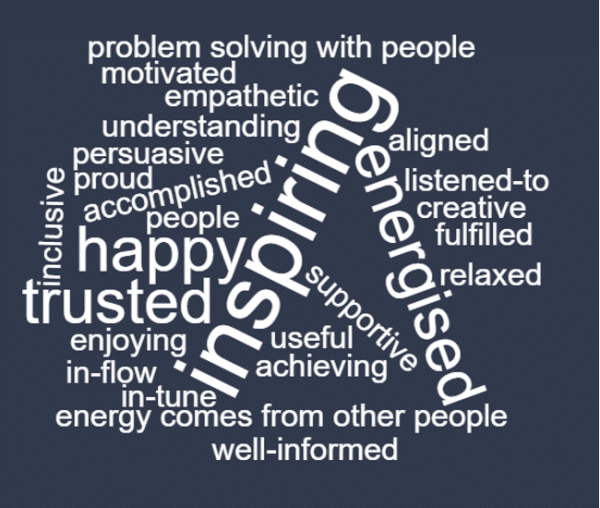
Figure 1. Leading on Good Days
When describing their leadership experiences on ‘good days’ participant descriptions surfaced many positive emotions including happiness and feeling trusted and energised. These positive emotions were linked to feeling connected with people, of creating a culture of belonging, the satisfaction gained from supporting and developing others and a sense of being energised and in flow. On good days the sense of shared purpose was clear and gave a sense of alignment in the organisation which created forward momentum.
Table 1. Themes from Leading on Good Days
| THEME | ILLUSTRATIVE QUOTE |
| CONNECTION | I feel I’ve got a connection |
| BELONGING | Feeling that they kind of belong |
| SUPPORT | I’m a coach rather than a cop. People are inspired, supported, satisfied that they are making a difference in their day-to-day |
| POSITIVE EMOTIONS | I’m happy. I’m proud. And I would say I’m relaxed.
When I realised that somebody grew. And being happy is not having fun. It’s really feeling fulfilled. |
| FLOW AND ENERGY | I feel in flow with shared purpose. And that shared purpose gives me energy. |
| ALIGNMENT | I lead effortlessly, because it doesn’t come from my energy. It comes from everybody else’s energy, that aligns in the direction where I believe we all as an organisation are headed to. |
In contrast to leading on good days, descriptors associated with leading on ‘bad days’ are presented in Figure 2.
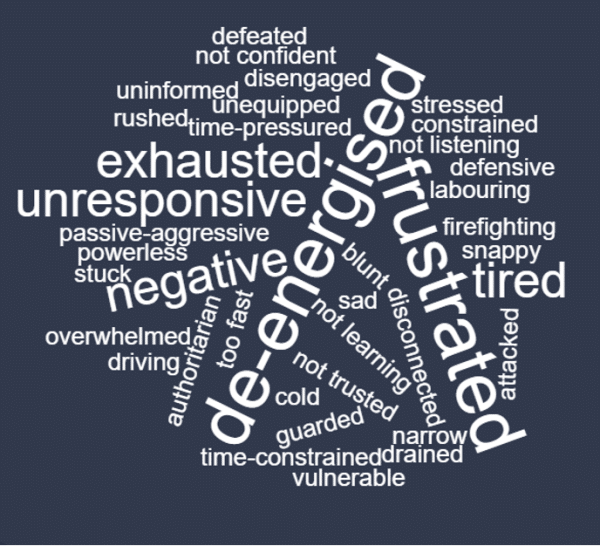
Figure 2. Leading on Bad Days
Analysis of leadership experiences on bad days indicated the negative aspects or converse of some of the themes associated with good days.
Table 2. Themes from Leading on Bad Days
| THEME | ILLUSTRATIVE QUOTE |
| DISCONNECTED | I feel disconnected from the team, from the people that surround me. I feel in a way, without spark in my eyes, without being able to transmit my kind of good wishes and desire to be there. |
| NEGATIVE EMOTIONS | I have to be very aware to stay above the negative emotions. But if I don’t feel calm, you know, myself, I’m sure that must come through in some way.
I feel my snappiest is when I feel as though other people’s frustration or other people’s annoyance is at the surface … I am not able to marshal the emotional fortitude to manage that in a way which would reduce their frustration |
| DRAINED ENERGY | I’m exhausted of it, and I have less time, but also less sort of ability to give the amount of emotional labour that I think people are looking for. |
| DRIVER | Me at my worst then I would probably want to drive things more than I should.
In my bad days, I haven’t listened and I haven’t learned. I think I’m in a rush. I have too many meetings. |
| DEFENSIVE | I feel as though I’m constantly playing defence and I’m constantly playing defence in ways that are, you know, requiring me to be kind of cold and hard, but also snappy on a lot of different things. What I seem is narrower and less capable of generating inspiring narratives. |
The themes highlight the relationship between poor energy and relationships with followers. Leadership on bad days was often associated with feelings of frustration leading to disengagement and defensiveness. Where on good days, participants were able to align decision-making and relational process, for some a bad day was associated with decision-making that was rushed, time-constrained, and lacked appropriate consultation.
Reflections
Despite the many pressures under which deans operate, the participant descriptions of good days were testimony to the positive emotions that nearly all participants associated with leading their schools. Descriptions of good days showed the importance of inclusive and relational leadership where women deans were able to work with, support and inspire their colleagues. The performative demands of their roles were also referenced, but typically achieved by working with people rather than in isolation. Leading on bad days was associated with a loss of energy and the need to manage negative emotional states. In the scope of this chapter, we identify, discuss and make recommendations centred on three key themes that emerged from our analysis; the importance of relational leadership; the navigation of dilemmas forcing trade-offs between performance and relationships and, the management of energy and emotional labour.
All deans interviewed referenced the importance of building strong relationships with members of their schools including both faculty and professional services. Uhl-Bien (2006, p. 655) describes relational leadership as, “a view of leadership and organisation as human social constructions that emanates from the rich connections and interdependencies of organisations and their members.” The deans in this study were aware of the importance of these interpersonal connections and when they were pressurised to make an authoritative decision without consultation, it became a source of stress for them. The benefits of the dean’s relational leadership for the business schools’ stakeholder management, had a shadow side or unintended negative consequence for the deans themselves. The potential danger of damaging these relationships created an intrapersonal discomfort and was a source of dissatisfaction for the deans.
Although relatively few of the descriptive terms associated with good days and bad days reference the importance of performance and school success, the supporting narratives from deans highlighted the need to make good decisions that would steer their organisations to success. On good days, this was working well. Conversely, bad days were associated with tension between adopting a consultative, relational approach and needing to make decisions quickly (quite often in response to demands from senior university leadership). This task-relationship conflict (Simons and Peterson, 2000) requires acceptance of the tension between contradictions embedded in everyday organisational life and according to Paradox Theory (Smith and Lewis, 2011), the embracing of a paradox mindset where leaders become accepting of and even energised by tensions (Miron-Spektor et al., 2018).
The management of personal energy was a key theme that for many differentiated good days from bad. Unlike the positive flow that was experienced on good days, bad days were often associated with a depletion of personal energy that could lead to suppressing negative emotions and sometimes emotional exhaustion. The construct of emotional labour may be defined as “the labour involved in dealing with other peoples’ feelings” (James, 1989:15), and concerns the energy taken to regulate feelings and expressions in fulfilling inter-personal work role expectations (Gabriel et al., 2020). Emotional labour is triggered by workplace events (Diefendorff et al., 2019). Although research on emotional labour has often focused on employees operating in the services sector (Hochschild, 1983), some studies have investigated emotional labour in the context of education leadership (Iszatt-White, 2009). A study of academic leaders found that deans exhibited higher levels of emotional labour than Vice Chancellors, but that in all cases, excessive emotional labour could take a heavy toll on university leaders (Heffernan and Bosetti, 2020).
Surface acting and deep acting are two types of emotional labour (Humphrey, 2023). The former entails suppressing emotions and altering facial expressions without actually changing the fully manifested emotion, which in turn can lead to emotional exhaustion. In the case of challenging problems, deep acting is a more beneficial strategy that calls for individuals to modify their emotions by feeling the emotion and cognitively assessing the triggers and organisational requirements before replying (Huang et al., 2015).
Conclusions and recommendations
Our engagement with women deans highlighted three themes, namely the importance of relational leadership, the navigation of dilemmas and the management of personal energy. These have implications for their own self-management and for the structural and systemic context within which deans function and for interventions that are designed to support their success.
The multiplicity of pressures and demands facing business school deans are undeniable. Not only do deans need support and learning spaces to prepare for their terms and gain as much of the knowledge and skills needed before they step into office; they also need to develop personal strategies to manage the pressures including distribution of leadership tasks, personal boundary and energy management and eliciting support.
We recommend engaging in peer learning communities and access to coaches or mentors to support women deans to recognise and regulate their energetic and emotional state in addition to garnering support from those to whom they report. We recommend that leadership development programmes for deans include a focus on building a paradox mindset which fosters the acceptance of and even being energised by tensions. Interventions could also focus on developing insight into the dangers of emotional exhaustion which can lead to burn-out and mechanisms to recognise and manage emotional labour. We recommend that it is helpful to develop and share coping strategies, including the value of deep acting of emotional regulation to enable cognitive reappraisal of situations that can lead to being triggered.
We suggest that senior university leadership need to understand the impact of demands on the deans at their schools to create effective talent retention strategies and cultures of care and support for those at the helm of these institutions. As our research shows, when women deans feel isolated, exhausted and frustrated this negatively impacts their ability to self-regulate, the quality of their relationships which triggers a more reactive, directive leadership style that can undercut a sense of shared purpose and alignment. Not only does this adversely affect the deans it also affects the school’s performance. Our findings suggest that it is in the best interest of all stakeholders to create systems of support for their women deans, through sensitivity to the dilemmas they experience, with regular discussions about performance in ways that support personal energy management across their tenures.
As woman deans work to hone the knowledge, skills and mindsets that support positive progress, their success cannot depend on them navigating solo. Superiors, supporters and followers in their eco-systems play an important role in supporting them to acknowledge and reduce their bad days and to grow, lean into and celebrate the good ones.

References
AACSB (2024a). Deans Survey Overview Report https://www.aacsb.edu/-/media/publications/data-reports/deans-and-senior-admin/deans-survey-overview-report-2023-24.pdf?rev=4d028411b37140f5ad41b26a5b7dcdbe&hash=E8F49163B9626AB327BA4A1A074331D5 (accessed 24 April, 2024)
AACSB (2024b). Promoting the Value of Business Education https://www.aacsb.edu/media-center/proof-points#:~:text=Approximately%206%20percent%20of%20the,innovation%2C%20and%20continuous%20process%20improvement (accessed 19 April, 2024)
Alajoutsijärvi, K. and Kettunen, K. (2016). The “Dean’s Squeeze” revisited: a contextual approach. Journal of Management Development, 35(3), pp.326-340.
Almog‐Bareket, G. (2012). Visionary leadership in business schools: an institutional framework. Journal of management development, 31(4), pp.431-440.
Amdam, R. P. and Elias, A. L. (2021). Business schools and the role of the executives’ wives. Academy of Management Learning & Education, 20(3), pp.300-319.
Barnabas, A., Anbarasu, J. and Clifford, P. (2010). The need for awareness of servant leadership in business schools. Academic Leadership, 8(2), pp.37-42.
Bedeian, A. G. (2002). The dean’s disease: How the darker side of power manifests itself in the office of dean. Academy of Management Learning & Education, 1(2), pp.164-173.
Blessinger, P. and Stefani, L. (2018). Inclusive leadership in higher education: Inclusion as a core institutional value. In Inclusive leadership in higher education (pp. 7-19). New York: Routledge.
Brown, A. D., Lewis, M. A. and Oliver, N. (2021). Identity work, loss and preferred identities: A study of UK business school deans. Organization Studies, 42(6), pp.823-844.
Cairns-Lee, H., Lawley, J. and Tosey, P. (Eds.). (2022). Clean Language interviewing: Principles and applications for researchers and practitioners. Bingley: Emerald Group Publishing.
Clements, C. (2012). Redemption in the Dean’s Office, The Journal of Values-Based Leadership, 5(1),6. https://scholar.valpo.edu/jvbl/vol5/iss1/6
Davies, B. J. and Davies, B. (2006). Developing a model for strategic leadership in schools. Educational Management Administration & Leadership, 34(1), pp.121-139.
Davies, J. (2015) Reflections on the role of the business school dean. Chartered Association of Business Schools, London. ISBN 978-0-9567461-7-7.
Davies, J. (2016). Are business school deans doomed? The global financial crisis, Brexit and all that. Journal of Management Development, 35(7), pp.901-915.
Davies, J., Thomas, H., Cornuel, E. and Cremer, R. D. (2023). Leading a business school (p. 234). Abingdon: Taylor & Francis.
Deloitte (2022) Deloitte Global Boardroom Program’s Seventh Edition https://www.deloitte.com/global/en/services/risk-advisory/research/women-in-the-boardroom-seventh-edition.html (accessed 24 April, 2024)
DePaolo, C. A. and Wilkinson, K. (2014). Get your head into the clouds: Using word clouds for analyzing qualitative assessment data.
Dhanani, A. and Baylis, R. M. (2024). Elite UK Business Schools: from cathedrals of learning to cathedrals of earning?. Studies in Higher Education, 49(3), pp.505-517.
Diefendorff, J. M., Gabriel, A. S., Nolan, M. T. and Yang, J. (2019). Emotion regulation in the context of customer mistreatment and felt affect: An event-based profile approach. Journal of Applied Psychology, 104(7), pp.965–983.
Eagly, A. H. and Karau, S. J. (2002). Role congruity theory of prejudice toward female leaders. Psychological Review, 109(3), pp.573-598.
Emblemsvåg, M.S. and Emblemsvåg, J. (2023). How Bad Leaders Can Drive Out Good Leaders. Journal of Leadership Studies, 17(3), pp.5-26.
Gallos, J. V. (2002). The dean’s squeeze: The myths and realities of academic leadership in the middle. Academy of Management Learning & Education, 1(2), pp.174-184.
Gabriel, A. S., Koopman, J., Rosen, C. C., Arnold, J. D. and Hochwarter, W. A. (2020). Are coworkers getting into the act? An examination of emotion regulation in coworker exchanges. Journal of Applied Psychology, 105(8), pp.907-929.
Gjerde, S. and Alvesson, M. (2020). Sandwiched: Exploring role and identity of middle managers in the genuine middle. Human relations, 73(1), pp.124-151.
Huang, J. L., Chiaburu, D. S., Zhang, X. A., Li, N. and Grandey, A. A. (2015). Rising to the challenge: Deep acting is more beneficial when tasks are appraised as challenging. Journal of Applied Psychology, 100(5), pp.1398-1408.
Heffernan, T. A. and Bosetti, L. (2020). The emotional labour and toll of managerial academia on higher education leaders. Journal of Educational Administration and History, 52(4), pp.357-372.
Humphrey, N. M. (2023). Emotional labour and employee outcomes: A meta-analysis. Public Administration, 101(2), pp.422–446.
Iszatt-White, M. (2009). Leadership as emotional labour: The effortful accomplishment of valuing practices. Leadership, 5(4), pp.447-467.
James, N. (1989). Emotional labour: skill and work in the social regulation of feelings. The Sociological Review, 37(1), pp.15-42.
MBA.today (2024). List of Triple-Accredited Business Schools (AACSB, EQUIS, AMBA) 2024, accessed 24 July, 2024 at https://www.mba.today/guide/triple-accreditation-business-schools
McFadden, M. (2021). Examining and comparing good and bad leaders based on key leadership characteristics: A leadership case study. International Journal of Organizational Innovation (Online), 13(3), pp.275-281.
Massner, C.K., Epling, L., Cade, N. and Breckenridge, R. (2022). Relational Leadership: Advancing Leaders in Higher Education through Mentoring. In Leadership for Sustainable and Educational Advancement-Advancing Great Leaders and Leadership. IntechOpen. Speaks about mentorship for developing relational leaders.
Miron-Spektor, E., Ingram, A., Keller, J., Smith, W. K. and Lewis, M. W. (2018). Microfoundations of organizational paradox: the problem is how we think about the problem. Academy of Management Journal, 61(1), pp.26-45.
Simons, T. L. and Peterson, R. S. (2000). Task conflict and relationship conflict in top management teams: the pivotal role of intragroup trust. Journal of Applied Psychology, 85(1), pp.102-111.
Smith, W. K. and Lewis, M. W. (2011). Toward a theory of paradox: a dynamic equilibrium model of organizing. Academy of Management Review, 36(2), pp.381-403.
Thomas, H and Thomas, L. (2011). Perspectives on leadership in business schools. Journal of Management Development, 30(5), pp.526-540.
Thomas, H., Lee, M., Thomas, L. and Wilson, A. (2014). Securing the future of management education: Competitive destruction or constructive innovation? Bingley: Emerald Group Publishing.
Tosey, P., Lawley, J. and Meese, R. (2014). Eliciting Metaphor through Clean Language: An Innovation in Qualitative Research. British Journal of Management, 25(3), pp.629-646.
Uhl-Bien, M. (2006). Relational leadership theory: Exploring the social processes of leadership and organizing. The Leadership Quarterly, 17(6), pp.654-676.
Wanderley, S., Alcadipani, R. and Barros, A. (2021). Recentering the global South in the making of business school histories: dependency ambiguity in action. Academy of Management Learning & Education, 20(3), pp.361-381.
Caren Scheepers is a Full Professor at the University of Pretoria’s Gordon Institute of Business Science (GIBS) in South Africa. Caren has a PhD in psychology and is a professional coach. She has coauthored a book on women leadership in emerging markets as well as several academic articles and case studies in this domain.
Heather Cairns-Lee is affiliate Professor of Leadership and Communication at IMD, Switzerland. Her teaching, research and case writing focus on sensemaking, the management of change, inclusive culture and effective communication. Heather’s research, teaching and case writing have all won international awards. She is one of the pioneers of Clean Language Interviewing in managerial settings and co-author of Clean Language Interviewing: Principles and Applications.
Nicola Kleyn is an Extraordinary Professor at the University of Pretoria’s Gordon Institute of Business Science (GIBS) in South Africa. Formerly she was Dean of GIBS and Dean of Executive Education at Rotterdam School of Management in the Netherlands. Nicola’s teaching and research are focused on corporate branding, reputation, and latterly, the theme of academic leadership.