AI Leaders, is a bold initiative co-funded by the European Union that seeks to reshape how business schools across Europe teach artificial intelligence ensuring its focus on ethics and best practices blending cutting-edge technology with strong ethical foundations and build to build a smarter, more conscious workforce for Europe. Through a partnership of universities including the UPF Barcelona School of Management, the University of Lodz, the University of Porto, as well as as well as ACEEU, the European E-Learning Institute and Feltech SI, the project is creating open-access tools that bring AI ethics and real-world applications into the classroom. Through dynamic case studies, hands-on materials, and innovation-driven hackathons, AI Leaders is equipping the next generation of business leaders with the right tools to harness AI responsibly.
AI Leaders is a project co-funded by the European Union that seeks to improve AI education in business and management schools.
“We are developing openly available resources that empower faculty to teach both the ethical principles and practical applications in AI and entrepreneurship. The goal is to prepare future business leaders to develop and apply AI solutions that align with European values and ethical guidelines, creating a highly skilled workforce across Europe,” explains Professor Rodrigo Cetina-Presuel, from UPF Barcelona School of Management.
To achieve its goals, the AI Leaders project has brought together UPF Barcelona School of Management (UPF-BSM), the Faculty of Management at the University of Lodz (the Project Lead), the Faculdade de Economia at Universidade do Porto as well as ACEEU, the European E-Learning Institute and Feltech Software Innovations.
Developing Open Resources for AI Education
A key component of the AI Leaders project is the development of openly available educational materials that empower faculty to teach both the ethical principles and practical applications of AI. These resources are designed to be flexible, allowing educators to adapt them to their specific courses and learning objectives.
The AI leaders Team is developing three different kinds of content:
- Responsible AI Case Studies and an Introductory Toolkit: This foundational resource provides knowledge on AI applications in real-world business scenarios while raising awareness of the ethical dilemmas that may arise.
- AI Open Educational Resources (OER): A structured set of learning materials based on real-world case studies, enabling instructors to incorporate AI-related assignments into their curriculum. These resources allow educators to mix, match, and customise content according to their specific needs.
- AI in Business Management Hackathons: These events offer students an interdisciplinary approach to learning about AI’s ethical considerations in business. Hosted at the partner universities, these hackathons will be documented in a guide to facilitate replication at other institutions.
All materials developed under the AI Leaders project are open source and freely available under a Creative Commons license, ensuring broad accessibility and encouraging adoption across higher education institutions.
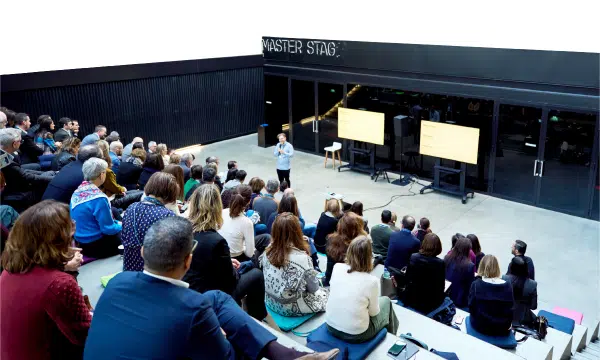
During the initial phase of the project, the AI Case Studies and Introductory Toolkit were introduced through simultaneous Orientation Days at Lodz, Porto, and UPF-BSM. Faculty members from all three institutions participated, testing the materials and providing valuable feedback for improvement. This iterative process ensures that the final resources are both effective and relevant to real-world AI applications in business and management.
Ethical AI: A Priority for Business Education
According to Professor Rodrigo Cetina-Presuel of UPF Barcelona School of Management, the AI Leaders project is designed to train business leaders who can drive AI adoption responsibly, “the goal is not just innovation for innovation’s sake, but to innovate for progress and positive societal impact.”
At UPF-BSM, integrating technological content into business education has been a priority for years. Courses on AI, data analytics, blockchain, and programming languages such as Python are increasingly common.
Professor Ana Freire from UPF-BSM notes that students are actively seeking more applied AI content across various disciplines, “far from being intimidated by these topics due to a lack of familiarity, students are actively requesting more applied content across various disciplines. This growing interest highlights a crucial need to prepare students to engage with these technologies in meaningful and responsible ways.”
Freire emphasises that faculty are also eager to integrate real-world AI applications into their teaching. However, ensuring that AI is implemented ethically requires careful consideration, “by providing educators with ready-made resources and practical case studies, the AI Leaders project helps faculty teach AI in a way that aligns with ethical principles and our institutional mission.”
Professor Bastida highlights the project’s broad focus on ethical AI use across various business domains, including marketing, human resources, supply chain management, accounting, and finance. By embedding ethical considerations across these core areas, the AI Leaders project promotes responsible AI adoption in both academic and professional settings.
At the University of Lodz, Professors Bartosz Kalinowski and Artur Modilinski see participation in the AI Leaders project as a significant opportunity to deepen AI ethics understanding, “As AI technologies become increasingly integrated into society, comprehending their ethical implications is essential.” The project prepares students to navigate the digital era by equipping them with AI-related skills, fostering critical thinking, and ensuring that AI-driven decisions are fair and transparent.

At the University of Porto, Professor Fabio Duarte underscores the institution’s commitment to ethical AI adoption in business education. One of its current projects involves developing an AI chatbot for students and faculty, with a strong emphasis on ethical guidelines and fair use.
Duarte points out that guiding students on the ethical use of AI in academic research and master’s theses is a priority, “while AI can support learning and research, it is essential to ensure transparency, respect for intellectual property, and academic integrity.” The university is implementing clear guidelines to help students critically assess AI-generated content and properly acknowledge its use.
A significant challenge at Porto has been encouraging faculty to integrate AI into their teaching. Many educators remain hesitant, unsure of how AI will impact knowledge creation and assessment methods. To address these concerns, discussions within the Pedagogical Council are shaping institutional strategies to support faculty in adopting AI responsibly.
The university is also developing practical AI solutions that adhere to ethical principles. The FEP AI chatbot, for example, is designed to assist students and faculty while mitigating risks related to misinformation, plagiarism, and privacy concerns. “Bringing AI into higher education requires balancing innovation with responsibility,” Duarte states, “through AI Leaders, we are ensuring that future business leaders develop both technical skills and strong ethical awareness.”
By balancing technological progress with ethical considerations, the AI Leaders project is not just shaping AI education—it is shaping the future of responsible AI-driven business leadership in Europe.

Rodrigo Cetina-Presuel is the Associate Dean for Education and Academic Affairs and a Senior Lecturer in Law and Public Policy at the UPF Barcelona School of Management (UPF-BSM).
Ana Freire is Vice-dean of Social Impact and Academic Innovation at UPF Barcelona School of Management, and PhD in Computer Science.
Ramón Bastida Vialcanet is Associate Professor at the UPF Barcelona School of Management.
Bartosz Kalinowski, Professor at the Faculty of Management at the University of Lodz, with 20 years of experience in teaching and research, and Head of the Department of Logistics at the Faculty of Management, University of Lodz.
Artur Modliński is an Associate Professor in the Department of Management and head of the Centre for Artificial Intelligence and Cybercommunication Research at the University of Lödz.
Fábio Duarte obtained a degree in Management in 2009, an MSc in Economics in 2011, and a PhD in Economics (Finance) in 2016. He is currently a Professor at the Faculty of Economics, University of Porto, and a Researcher at cef.up with articles published in several international journals.